As global supply chains face increasing fragility through climate and conflict disruptions, Garden Earth shows that the technocratic, expert-led model of industrial food globalization is nearing its endpoint.
Thanks for reading Lizzy's Newsletter! Subscribe for free to receive new posts and support my work.
September 13, 2023, https://seeds.ca/schoolfoodgardens/the-impact-of-globalization-on-the-food-system/
While the high-tech Green Revolution 2.0 is globally effective in raising crop yields, restoring decentralized small farms is far superior in: a) protecting local ecosystems, b) boosting rural economies, and c) ensuring food sovereignty.
Decades of agricultural data show that small, diversified farms actually produce more total food per acre than giant monoculture (single-crop) farms. They also protect thousands of rare, traditional seed varieties and animal breeds that giant corporations ignore.
A classic study of California's San Joaquin Valley found that towns surrounded by small family farms have stronger social ties, better schools, more local businesses, and higher civic engagement than towns surrounded by giant corporate farms.
“Organic Farming vs The Green Revolution,” Nov. 16, 2023, https://www.glucorp.com/blog/organic-farming-vs-the-green-revolution
In addition to the cultural and economic benefits of small farms, Garden Earth takes the holistic view that for eons of time, proximity to Nature has been essential to the welfare of the human spirit.
Indeed, food-sufficient countries are reported to be generally happier:
The ten countries listed as the most self-sufficient in food production—Guyana, Vietnam, China, Oman, Vanuatu, Laos, the Philippines, Kyrgyzstan, Uzbekistan, and Latvia—all score above the baseline global average on the World Happiness Report.
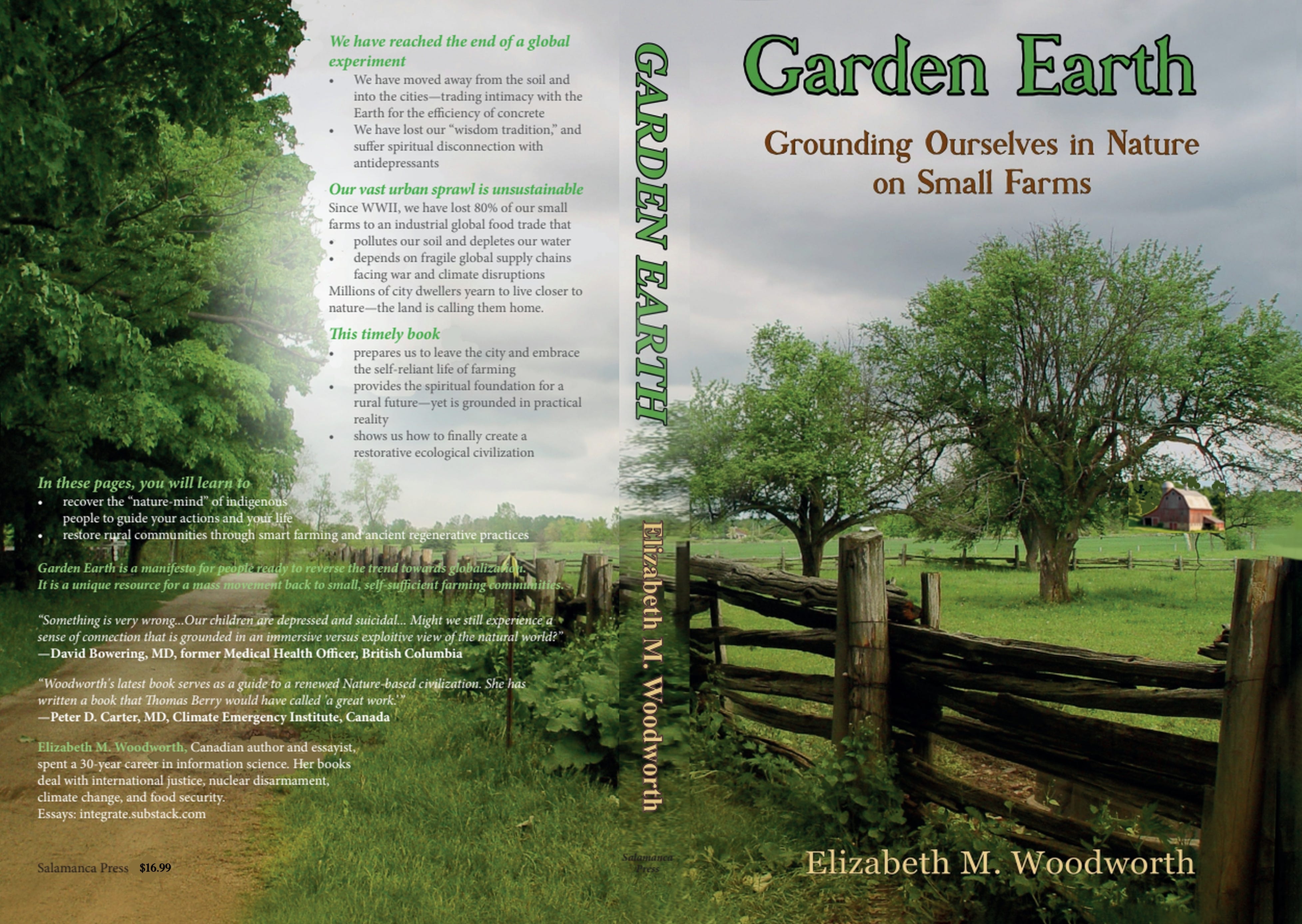
In view of this fact, Garden Earth, released in July 2026,is both a spiritual manifesto and a practical road-map for restoring the 80% of small farms that North America has lost since World War II.
In his foreword to Garden Earth, Dr. Peter Carter, founder of the Climate Emergency Institute,highlights the village self-rule model that Mathatma Gandhi encouraged:
Woodworth explains the destructiveness of economic globalization, and takes us back to the traditional ideal of civilization as Nature-respecting small farms that sustain villages.
Her latest book serves as a guide to a renewed Nature-based civilization. She has written a book that Thomas Berry would have called ‘a great work. Woodworth’s mission is the same as Berry’s, which, in his words, is the transition from the period of human devastation to a mutually beneficial presence with Earth.
The current crisis is a far cry from the Hawaiian fisherman, who enters the ocean, “not to make trouble, but by excusing himself, asking permission from the wildlife,” before casting a line. Immersed in this ancient “nature-mind,” he is not above Nature; he is inside it.
“Hawaiian Net Caster,” photo by Fritz Henle, 1947
Urban humanity has been drifting further and further away from this inborn reverence for nature that was based on the ancient, cross-cultural “wisdom tradition” in pre-industrial, parish-based Europe.
To rescue our future, we must recover our ability to listen to Nature’s universal connectedness and restore the small, self-reliant farming communities that once defined our humanity.
Garden Earth prepares a new generation to exchange concrete and asphalt for a homesteading life in the open air. Its “how to” chapters connect readers to official US and Canadian farming assistance programs, supportive farming organizations, and ancient soil and composting wisdom combined with modern off-grid technologies.
Award-winning conservation biologist Dr. Reese Halter writes:
Canadian researcher Elizabeth Woodworth has assembled a tour de force of coming home to nature, our Mother. In this frenetic world, the medicine for community, health, spirituality and mental well-being is reconnecting with the natural world. It starts with recognizing the importance of all animals to the stability of ecosystems and moves onto care-giving the soil and growing our own food.
Original themes in Garden Earth include:
Crops that reduce world trade, such as fruits, soybeans, oil seeds, myriad hemp products, and bamboo
Economic sovereignty through specialty crops like, saffron, goji berries, ginger, ginseng, gourmet mushrooms, and culinary herbs
Regenerative soil recovery through Sir Albert Howard’s deep-humus soil and composting traditions to heal depleted farmlands
Restoring nature-mind through the intimacy with nature found in indigenous and historical cultures
Creating a nature-based, ecological civilization harmonizing economic development with protection of biodiversity
This week Elizabeth will be interviewed for 25 minutes by Marianne Pestana for her ABC Network radio audience of 3.5 million listeners:
Tune in Wednesday July 8th at 8 AM Pacific, and Weds. July 15th at 8 AM Pacific time (KMET, 1490 AM, 98.1 FM).
Elizabeth M. Woodworth, Canadian author and essayist, spent 30 years in information science. Her books deal with international justice, nuclear disarmament, climate change, and food security.
Thank you for sharing this excellent and well-deserved praise for your book. Right now I'm spending a week in a remote mountain valley in East Tyrol, Austria. Staying at a small farm that has been in the family for generations. Life here is still very traditional (though now with some solar panels and WiFi), with hard work, social cohesion and close connection to nature. The breakfast table is full of decisions products from the farm: herbal tea, yogurt, bread, butter, cheese, homemade salami and prosciutto, eggs, jam, honey. Oh and the mountain scenery and hiking opportunities are breath-taking. A bit of paradise.





I just volunteered at the Modern Homesteading conference in Coeur D'Alene Idaho and this is indeed a powerful spiritual moment.
Thank you for sharing this excellent and well-deserved praise for your book. Right now I'm spending a week in a remote mountain valley in East Tyrol, Austria. Staying at a small farm that has been in the family for generations. Life here is still very traditional (though now with some solar panels and WiFi), with hard work, social cohesion and close connection to nature. The breakfast table is full of decisions products from the farm: herbal tea, yogurt, bread, butter, cheese, homemade salami and prosciutto, eggs, jam, honey. Oh and the mountain scenery and hiking opportunities are breath-taking. A bit of paradise.